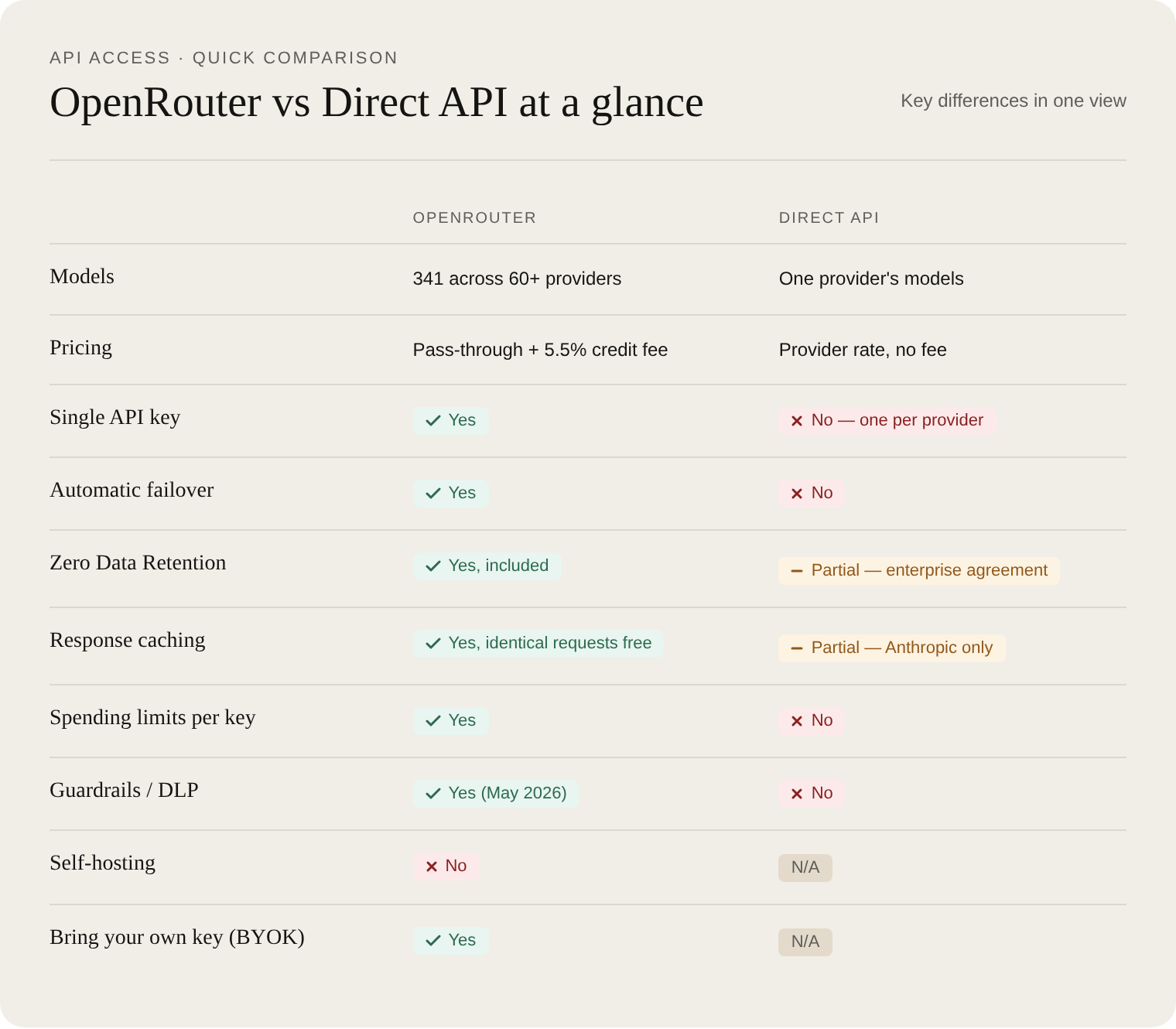
OpenRouter routes your API calls through a single endpoint with access to 341 models across 60+ providers. Direct API access (your own keys from Anthropic, OpenAI, or Google) gives you the same models with no intermediary and no added fee. Both approaches use pay-per-token pricing, and OpenRouter passes through provider rates without any markup on inference.
OpenRouter gives you one API key, one billing dashboard, and automatic failover when a provider goes down. Direct APIs give you none of that, but also no added fee and no intermediary in the request path. This article covers what you're trading when you choose between them.
Quick comparison
What direct APIs give you
When you call Anthropic, OpenAI, or Google directly, you pay exactly the listed token price with no intermediary. You get a direct relationship with the provider, native access to every provider feature, and potential volume discounts or enterprise agreements at scale. Anthropic's models, for example, are available directly or through AWS Bedrock, Vertex AI, and Microsoft Foundry.
The tradeoff is operational overhead. Each provider is a separate integration: its own API key, billing dashboard, rate limit tier, and SDK. When the state of the art shifts (which it does week to week), you add another key, another balance to monitor, another integration to maintain. For teams calling a single provider with no plans to change, this is a non-issue. For everyone else, it compounds quickly.
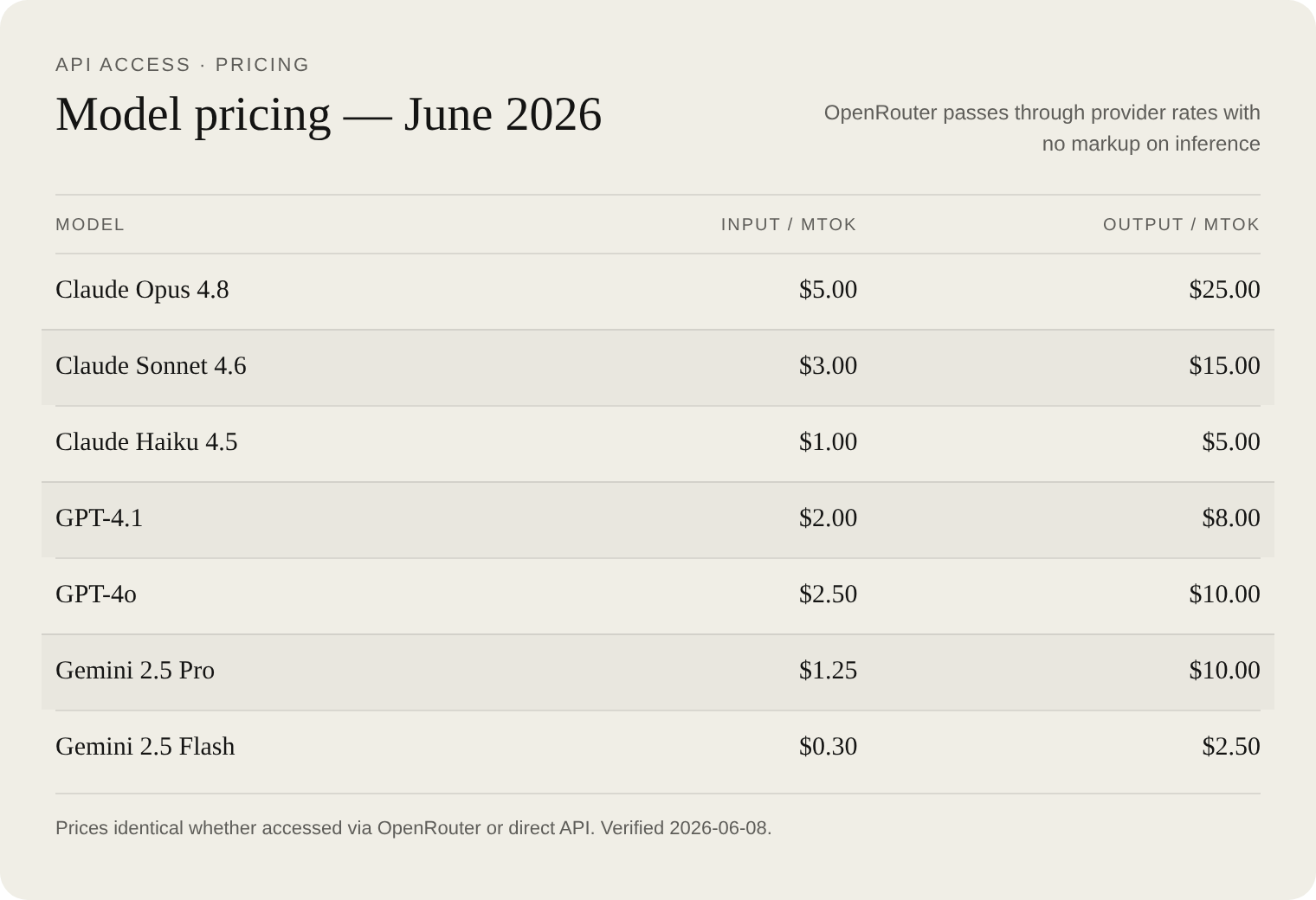
Current pricing for top models, as of June 2026:
What OpenRouter adds
OpenRouter is a proxy that speaks the OpenAI API format. You point your existing code at https://openrouter.ai/api/v1, swap in your OpenRouter key, and every model from every provider becomes accessible with no restructuring and no SDK changes. Here's what that buys you in practice.
Access 300+ models with a single API key
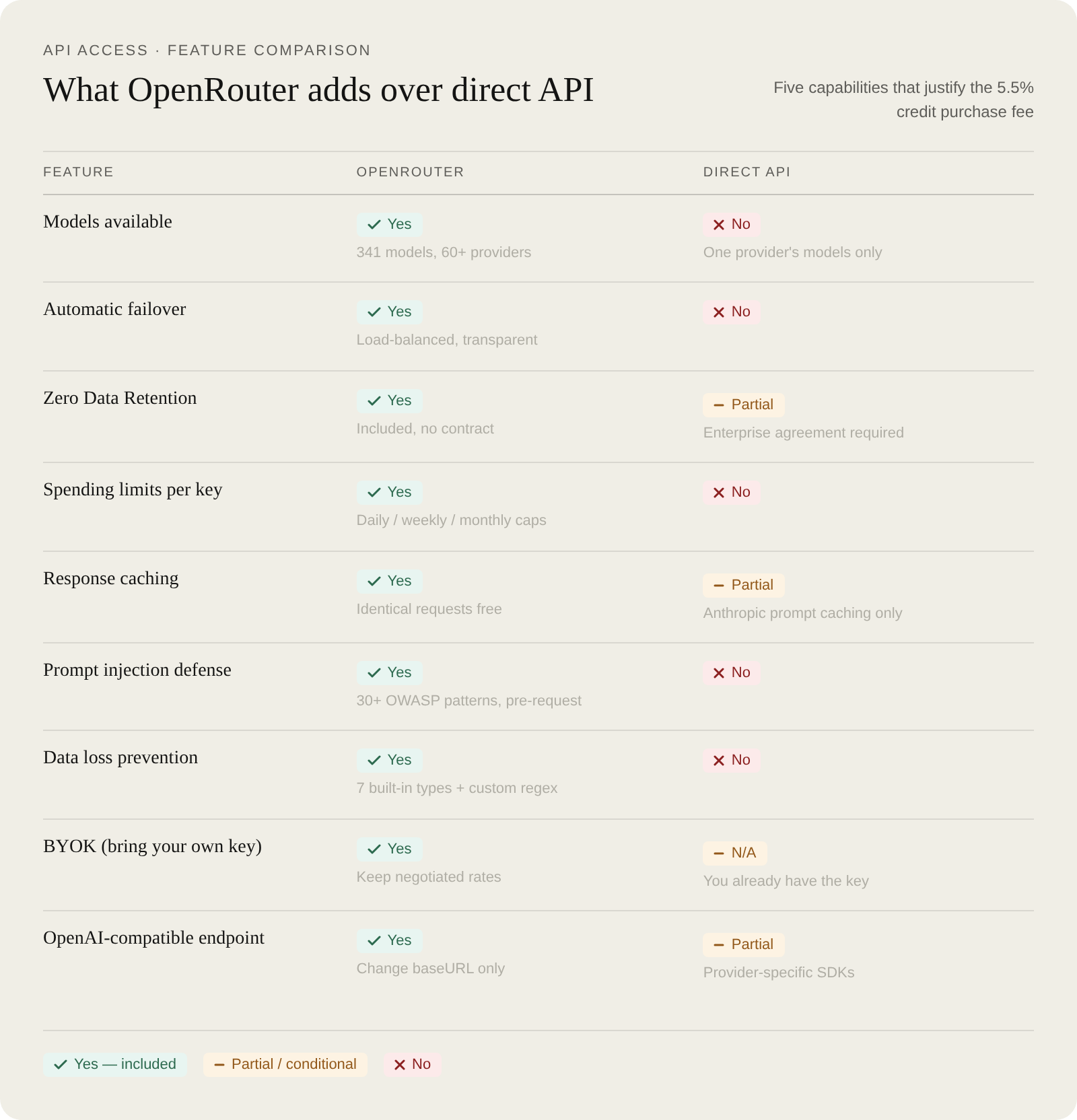
341 models from 60+ providers under a single credit balance and usage dashboard. When a new model ships, it's available immediately with no new key and no new integration. OpenRouter also offers an Auto Router (openrouter/auto) that picks the model for you based on prompt complexity, routing simple prompts to cheaper models and complex ones to more capable ones. The platform has partnerships with major labs and often adds new models on release day.
Automatic failover across providers
OpenRouter's default load balancing prioritizes providers that haven't seen significant outages in the last 30 seconds, then weights stable providers by inverse square of price. If the primary provider fails, it falls back transparently. The Model Fallbacks feature lets you specify a fallback model explicitly (for example, route to Claude Sonnet if Claude Opus is down or rate-limited). Errors that can trigger fallback include context length issues, content moderation flags, rate limiting, and downtime. For production apps, this replaces custom retry logic.
Zero Data Retention without an enterprise contract
OpenRouter does not store your prompts or responses by default. Logging is opt-in only. Getting Zero Data Retention directly from Anthropic or OpenAI typically requires an enterprise agreement with legal review and enough volume to justify the special treatment. OpenRouter negotiates these agreements at the infrastructure level. Enable ZDR once at the account level and every request routes only to compliant endpoints, no contract required.
One practical detail: for top commercial models like Claude Sonnet 4.6 and GPT-4.1, ZDR routing typically goes through Azure or Google Vertex (where OpenRouter has ZDR agreements in place) rather than directly through Anthropic or OpenAI. This is why the provider-allowlist matters: you can restrict ZDR traffic to US-based, SOC 2-compliant providers, ensuring every hop in the chain actually honours the agreement.
Spending controls and guardrails
The Guardrails feature (launched May 2026) adds per-key spending limits with daily, weekly, or monthly reset windows. If a request exceeds the limit it fails with a 402, so a leaked key or runaway agent loop costs at most whatever cap you set. Guardrail budgets are per-entity, not shared: assign a $50/day limit to three team members and each gets their own $50 budget independently. API key limits layer on top of member limits.
Beyond budgets, Guardrails also include prompt injection defense (scanning against 30+ regex patterns from the OWASP LLM Prompt Injection Prevention Cheat Sheet before requests leave OpenRouter) and data loss prevention covering seven built-in sensitive information types plus custom regex for domain-specific data. None of this exists on direct provider APIs.
Response caching
Identical API requests return from cache at zero cost. When a cached response is available, OpenRouter returns it immediately with all billable usage counters reported as 0. Caching works across every model on the platform regardless of provider support, because it operates at the OpenRouter layer before the request reaches any provider. Enable it per-request with the X-OpenRouter-Cache header. Useful for agent loops that send repeated context, dev and test cycles, and FAQ bots with predictable inputs.
The 5.5% fee
The 5.5% fee applies when you purchase credits, not on inference. Model pricing passes through at provider rates with no markup on tokens. At $10/month, the fee is $0.55. At $100/month, it's $5.50. At $500/month, it's $27.50.
What does the 5.5% fee include?
Zero Data Retention that would otherwise require an enterprise contract, automatic failover replacing custom retry infrastructure, unified billing replacing three to five separate dashboards, and spending controls with no direct equivalent in provider APIs. As Peter Bray wrote in his April 2026 analysis of switching to OpenRouter in production: "$100 in credits costs $105.50. The 5.5% is the price of ZDR, spending limits, guardrails, and a unified API."
Bring your own key
If you have existing volume discounts or enterprise agreements with a provider, BYOK lets you use those keys through OpenRouter's interface. You keep your negotiated rates and still get OpenRouter's routing and reliability layer. The first block of BYOK requests each month is free, with subsequent usage carrying a small fee deducted from your OpenRouter credits.
When direct APIs are still the right call
High-volume enterprise agreements
If you've negotiated committed spend contracts or volume discounts with a provider, routing through OpenRouter may add cost without adding proportional value. The BYOK option reduces this concern (you can bring your own keys and keep your rates), but if your compliance or procurement process is already set up for a direct relationship, there's limited reason to add a layer.
You only use one provider
If your entire stack runs on one provider and model diversity is not on the roadmap, you gain very little from a gateway and the 5.5% fee is pure overhead. The failover, multi-model access, and unified billing features only matter if you're using more than one provider.
You need self-hosting or strict data residency
OpenRouter has no self-hosted or on-premises option. EU in-region routing is available, but only on the enterprise tier. Regulated industries with stricter requirements than OpenRouter's standard offering will need to evaluate direct provider options or self-hosted gateways.
How to connect
If you're already using the OpenAI SDK, switching to OpenRouter is a single baseURL change with no other code modifications required.
Python:
from openai import OpenAI

client = OpenAI(
    base_url="https://openrouter.ai/api/v1",
    api_key="<OPENROUTER_API_KEY>",
)
TypeScript:
import OpenAI from 'openai';

const openai = new OpenAI({
  baseURL: 'https://openrouter.ai/api/v1',
  apiKey: '<OPENROUTER_API_KEY>',
});
If you're starting fresh rather than migrating existing code, OpenRouter's native SDKs (@openrouter/sdk for TypeScript and openrouter for Python) are the better default. Both offer full type safety and auto-generated types from the OpenAPI spec without the OpenAI wrapper in between.
Which one should you use?
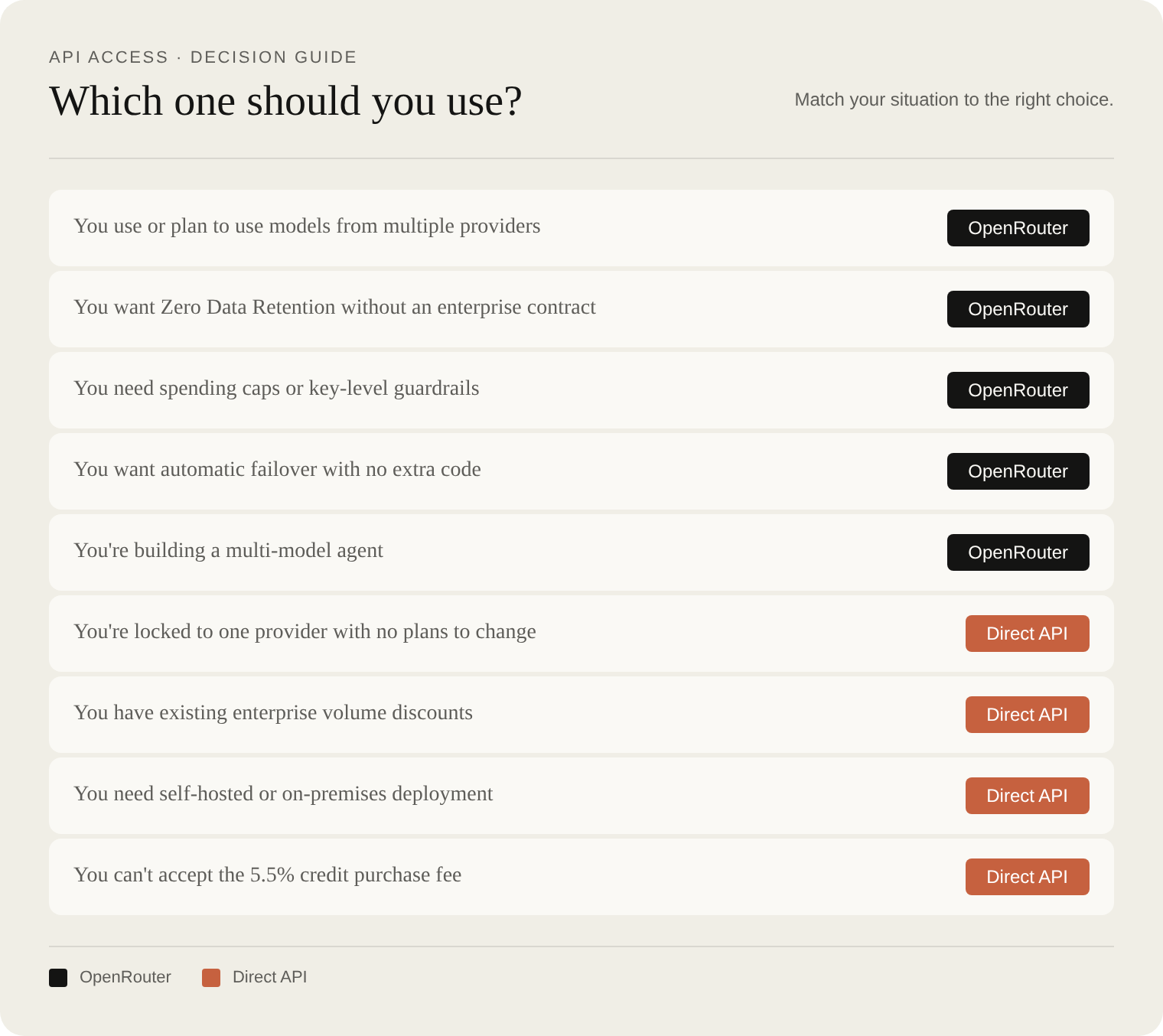
For most developers building multi-model applications, OpenRouter's infrastructure layer is worth the fee. The 5.5% buys real things: Zero Data Retention, unified billing, automatic failover, and spending controls that would take weeks to build yourself. If you're calling a single provider with no plans to change, the overhead isn't justified. Either way, switching is a one-line change.